We use minimal analytics to improve your experience. Privacy Policy

SymClarity
My Cards Gallery
Mindfulness Productivity Wellness
View All Categories
Challenge Purpose Analytics

Mindfulness & Productivity Card Gallery

Browse 1000+ AI-powered daily focus cards for mindfulness, productivity, and wellness. Get inspired by the SymClarity community's shared wisdom.

Focus
Sep 18, 2026

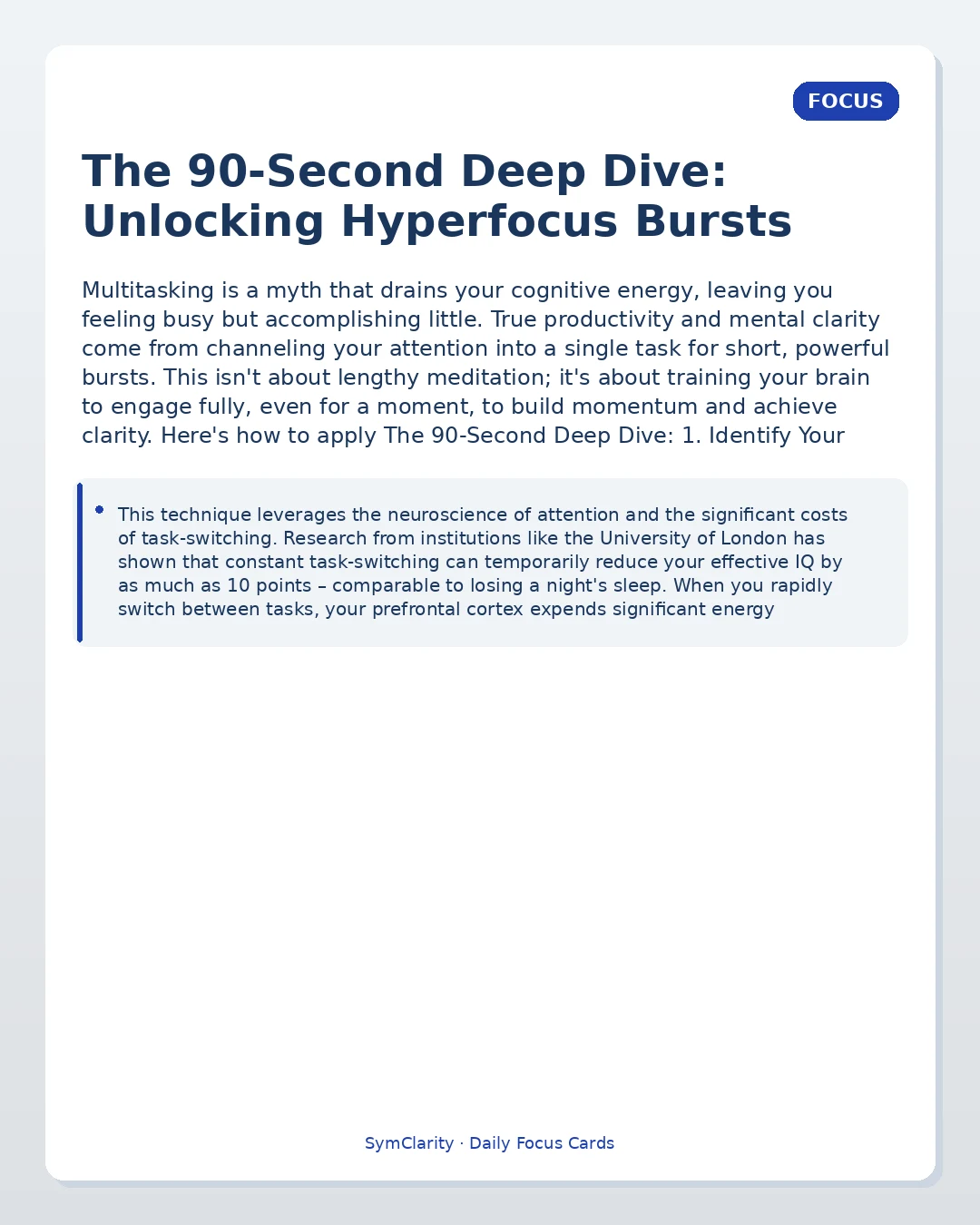
The 90-Second Deep Dive: Unlocking Hyperfocus Bursts

Multitasking is a myth that drains your cognitive energy, leaving you feeling busy but accomplishing little. True productivity and mental clarity come from channeling your attention into a single task for short, powerful bursts. This isn't about lengthy meditation; it's about training your brain to engage fully, even for a moment, to build momentum and achieve clarity. Here's how to apply The 90-Second Deep Dive: 1. Identify Your Target: Choose one specific, small task that needs your full attention. This could be writing a single paragraph of an email, reviewing one specific data point, or organizing one small section of your digital desktop. 2. Eliminate All Distractions: For the next 90 seconds, put your phone on silent and place it out of sight. Close all unnecessary browser tabs and applications. If possible, communicate to others that you need a brief moment of uninterrupted focus. Physically clear your immediate workspace of anything unrelated to your target task. 3. Engage Fully: Dive into that single task with complete, unyielding attention. Imagine your focus as a laser beam, cutting through everything else. If your mind wanders (and it will), gently acknowledge the thought and guide your attention back to the task at hand, without self-criticism. 4. Notice the Shift: After 90 seconds, consciously observe how much you accomplished, the clarity you gained, or the momentum you built. You'll often find that this short, intense burst feels more productive and satisfying than hours of fragmented attention. Example: Instead of vaguely aiming to "start that report," commit to "write the first three sentences of the introduction" for 90 seconds. Instead of "checking emails," focus on "drafting a concise, complete reply to one specific email" for 90 seconds. The goal is to prove to yourself the tangible power of undivided attention.
View Full Card Share Download
Focus card: The 90-Second Deep Dive: Unlocking Hyperfocus Bursts - Daily focus inspiration from SymClarity
Focus
Sep 18, 2026

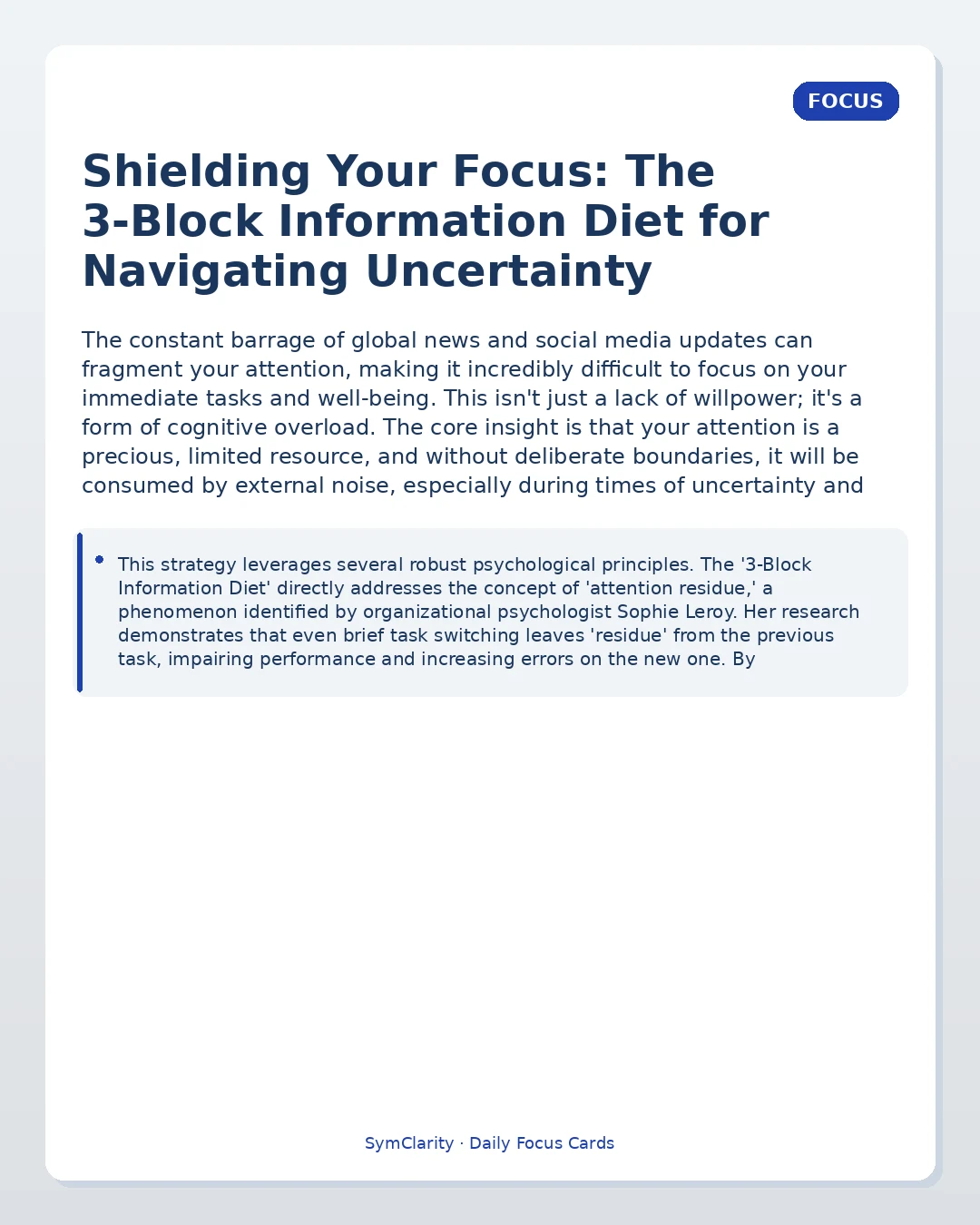
Shielding Your Focus: The 3-Block Information Diet for Navigating Uncertainty

The constant barrage of global news and social media updates can fragment your attention, making it incredibly difficult to focus on your immediate tasks and well-being. This isn't just a lack of willpower; it's a form of cognitive overload. The core insight is that your attention is a precious, limited resource, and without deliberate boundaries, it will be consumed by external noise, especially during times of uncertainty and heightened global tension. To combat this, adopt 'The 3-Block Information Diet & Anchor Breath' to reclaim your mental space and maintain your inner equilibrium. This strategy provides a structured approach to consuming information without letting it consume you. 1. Designate 3 Information Blocks: Choose three specific, non-overlapping 10-minute windows in your day for consuming news or social media (e.g., 8:30 AM, 12:30 PM, 6:00 PM). Outside these precise blocks, all news apps, social media platforms, and distracting websites are to remain closed. This isn't about avoidance, but about strategic containment of information flow. 2. Practice the Anchor Breath: Before each information block, and anytime you feel your attention drifting or anxiety rising outside these blocks, perform 3 cycles of the '4-7-8 Breath' (a technique popularized by Dr. Andrew Weil, rooted in ancient yogic pranayama). Inhale quietly through your nose for 4 counts, hold your breath for 7 counts, and exhale completely through your mouth with a gentle whoosh sound for 8 counts. This physiological sigh rapidly shifts your nervous system from sympathetic (fight or flight) to parasympathetic (rest and digest) dominance. 3. Real-World Application: Imagine you're a project manager trying to meet a critical deadline, but news alerts about a global crisis or political tension keep popping up on your phone. Instead of falling into an endless scrolling loop, you commit to your 12:30 PM information block. When an alert distracts you at 10 AM, you immediately close the app, perform 3 rounds of 4-7-8 breathing to recenter, and then calmly redirect your focus to the task at hand, knowing you have a dedicated, contained time to catch up on updates later. This simple act reduces decision fatigue, preserves cognitive energy, and empowers you to choose your focus.

View Full Card Share Download
Focus card: Shielding Your Focus: The 3-Block Information Diet for Navigating Uncertainty - Daily focus inspiration from SymClarity
Focus
Sep 18, 2026

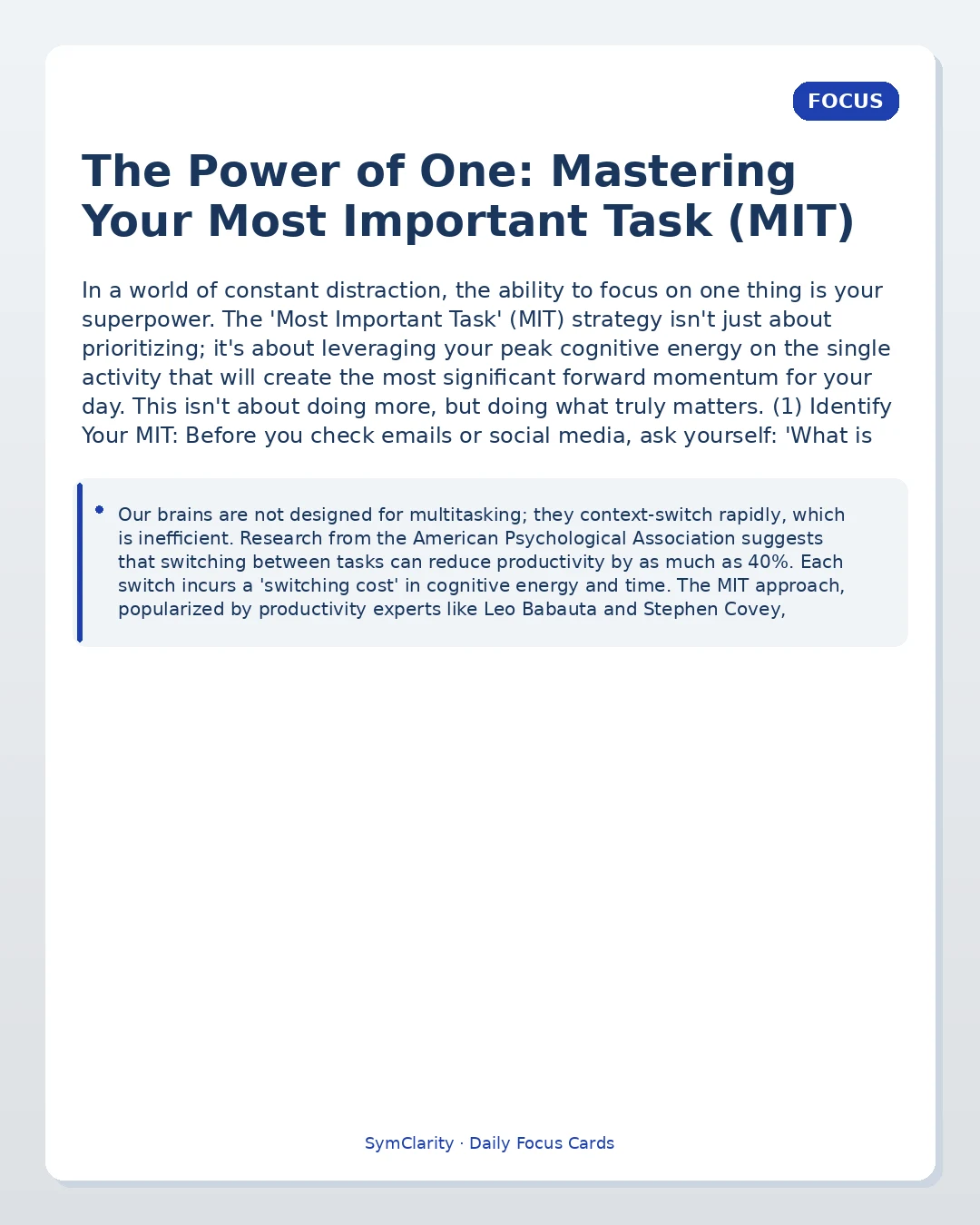
The Power of One: Mastering Your Most Important Task (MIT)

In a world of constant distraction, the ability to focus on one thing is your superpower. The 'Most Important Task' (MIT) strategy isn't just about prioritizing; it's about leveraging your peak cognitive energy on the single activity that will create the most significant forward momentum for your day. This isn't about doing more, but doing what truly matters. (1) Identify Your MIT: Before you check emails or social media, ask yourself: 'What is the ONE task that, if completed today, would make everything else easier or unnecessary?' This should be a high-impact, often challenging task that moves a key goal forward. (2) Time-Block and Protect: Dedicate a specific, uninterrupted block of time—ideally 60-90 minutes, or at least 25 minutes using the Pomodoro Technique—to ONLY this task. Close all unnecessary tabs, silence notifications, and inform others you are unavailable. (3) Engage Deeply: Immerse yourself fully in the MIT. If your mind wanders, gently bring it back to the task. Don't switch to another activity until the time block is complete or the MIT is finished. For instance, if you have a complex report due, several client calls, and a team meeting, your MIT might be 'Outline the Q3 financial report.' You'd block 7 AM to 8:30 AM, put on noise-canceling headphones, and write only that outline, deferring all other inputs until afterward.

View Full Card Share Download
Focus card: The Power of One: Mastering Your Most Important Task (MIT) - Daily focus inspiration from SymClarity
Focus
Sep 18, 2026

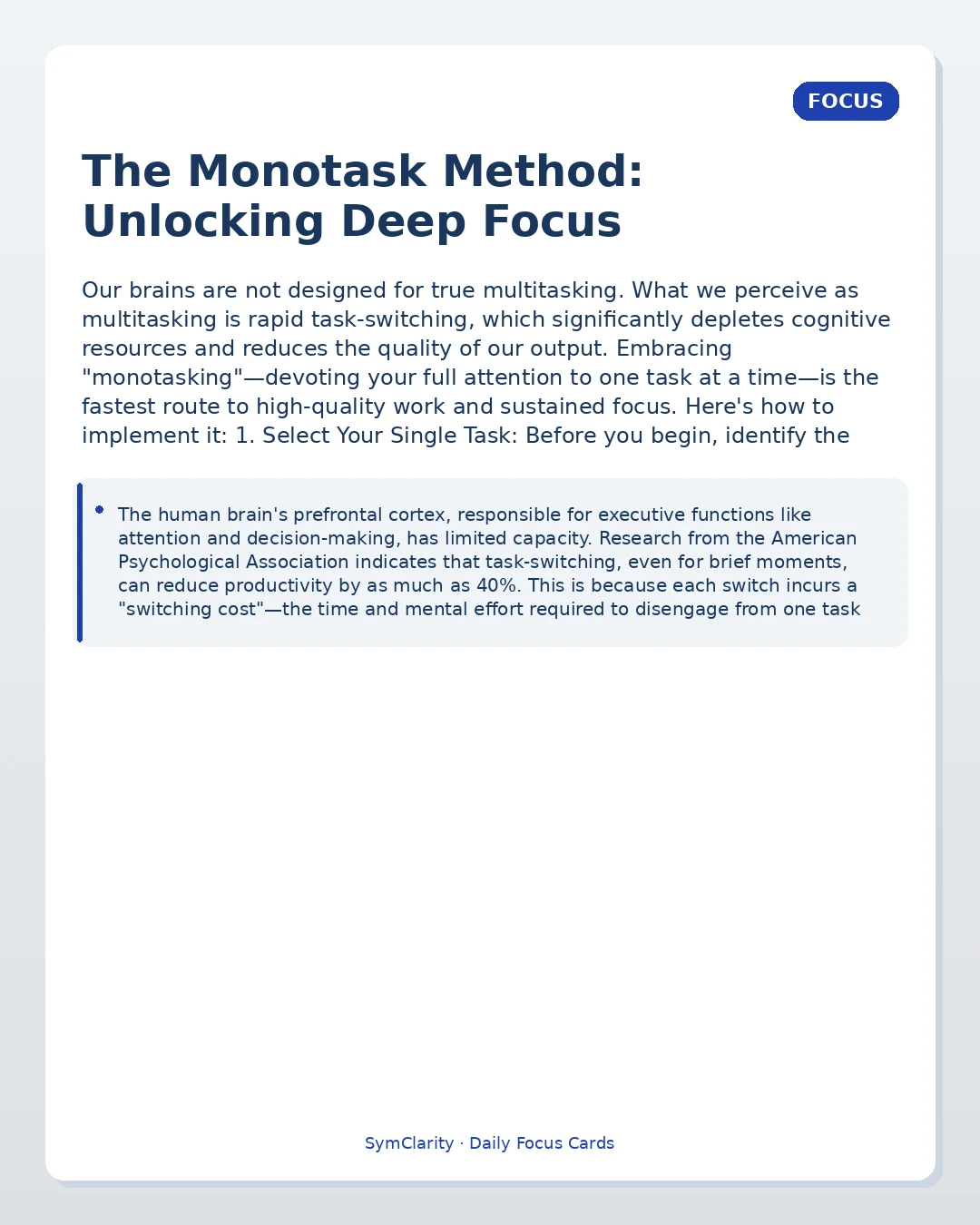
The Monotask Method: Unlocking Deep Focus

Our brains are not designed for true multitasking. What we perceive as multitasking is rapid task-switching, which significantly depletes cognitive resources and reduces the quality of our output. Embracing "monotasking"—devoting your full attention to one task at a time—is the fastest route to high-quality work and sustained focus. Here's how to implement it: 1. Select Your Single Task: Before you begin, identify the absolute most important task you need to accomplish. This isn't a list; it's just one item. 2. Isolate Your Environment: For the next 25-50 minutes (e.g., a Pomodoro cycle), remove all potential distractions. Silence notifications, close irrelevant browser tabs, put your phone in another room. 3. Commit and Engage: Begin working on only that single task. If your mind wanders, gently bring it back to the task at hand without judgment. 4. Scheduled Breaks: After your focused period, take a short, intentional break (5-10 minutes) to recharge before tackling your next single task. Example: A software developer tackling a complex bug will close all communication apps, silence their phone, and dedicate a focused block of 45 minutes solely to debugging that one issue, knowing that interruptions would force a costly mental re-entry.

View Full Card Share Download
Focus card: The Monotask Method: Unlocking Deep Focus - Daily focus inspiration from SymClarity
Clarity
Sep 18, 2026

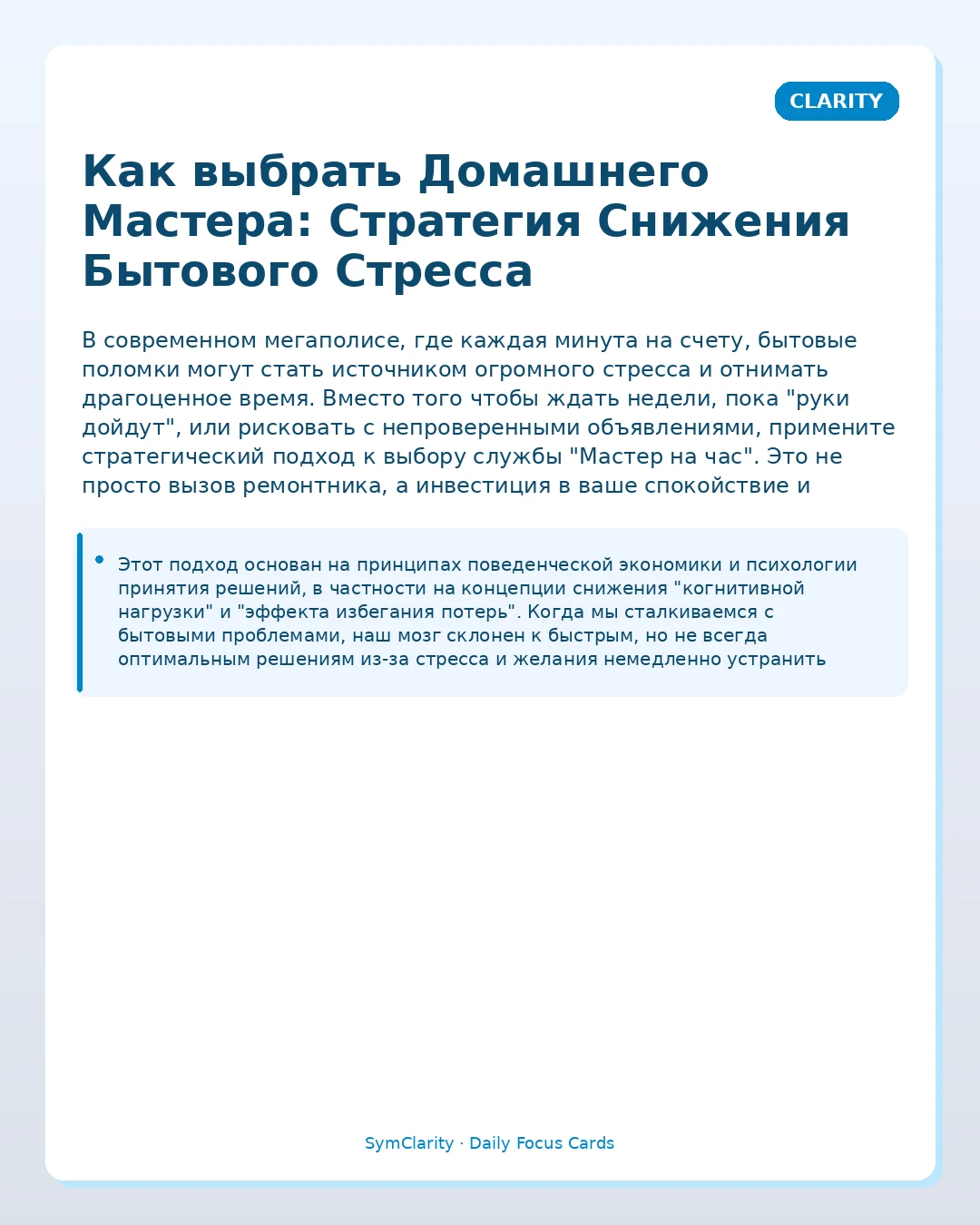
Как выбрать Домашнего Мастера: Стратегия Снижения Бытового Стресса

В современном мегаполисе, где каждая минута на счету, бытовые поломки могут стать источником огромного стресса и отнимать драгоценное время. Вместо того чтобы ждать недели, пока "руки дойдут", или рисковать с непроверенными объявлениями, примените стратегический подход к выбору службы "Мастер на час". Это не просто вызов ремонтника, а инвестиция в ваше спокойствие и эффективность. Вот как это сделать: 1. Оцените Срочность и Риск: Прежде чем звонить, четко определите масштаб проблемы. Течет кран — это срочно, но не катастрофа. Прорыв трубы — экстренная ситуация. Это поможет вам понять, сколько времени у вас есть на выбор и какой уровень гарантий вам нужен. 2. Примените "Правило Трех Источников": Не доверяйте одной рекламе. Проверьте отзывы о компании как минимум на трех независимых платформах (например, Яндекс.Услуги, Профи.ру, Google Maps или местные форумы). Ищите не только количество звезд, но и содержание комментариев: скорость приезда, вежливость, качество работы, прозрачность ценообразования. 3. Задайте Ключевые Вопросы по Телефону: Прежде чем подтвердить вызов, уточните: Среднее время прибытия специалиста (реалистично ли "в течение часа" для вашего района)? Какова фиксированная стоимость вызова и диагностики? Есть ли скрытые платежи? Предоставляется ли гарантия на выполненные работы и на какой срок (например, 3-6 месяцев)? Используются ли оригинальные запчасти или аналоги? Есть ли у мастера все необходимые инструменты? Какова процедура оплаты (наличные, карта, онлайн)? 4. Личное Впечатление и Документация: При приезде мастера обратите внимание на его пунктуальность, внешний вид и профессионализм. Убедитесь, что он готов предоставить смету до начала работ и акт выполненных работ после. Сохраняйте все чеки и гарантийные талоны. Пример: Ваш смеситель внезапно начал протекать. Вместо паники, вы вспоминаете о "Правиле Трех Источников", быстро просматриваете отзывы о нескольких компаниях, звоните в две лучшие, задаете уточняющие вопросы о гарантии и цене, и выбираете ту, что предлагает 6-месячную гарантию и четкий прайс. Мастер приезжает через 45 минут, быстро устраняет проблему, и вы получаете квитанцию с гарантией, избегая недельного стресса и потенциальных переплат.

View Full Card Share Download
Clarity card: Как выбрать Домашнего Мастера: Стратегия Снижения Бытового Стресса - Daily focus inspiration from SymClarity
Clarity
Sep 16, 2026

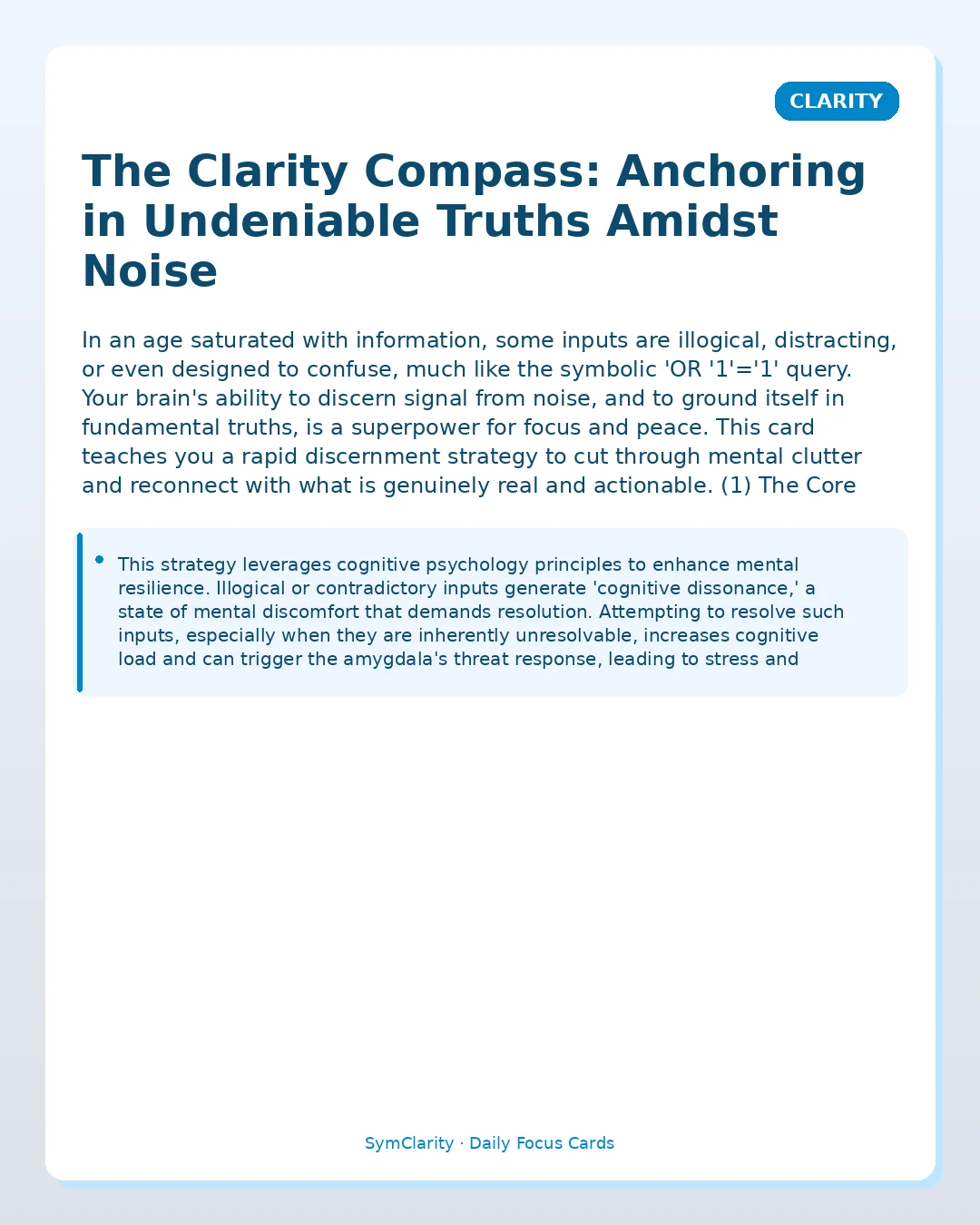
The Clarity Compass: Anchoring in Undeniable Truths Amidst Noise

In an age saturated with information, some inputs are illogical, distracting, or even designed to confuse, much like the symbolic 'OR '1'='1' query. Your brain's ability to discern signal from noise, and to ground itself in fundamental truths, is a superpower for focus and peace. This card teaches you a rapid discernment strategy to cut through mental clutter and reconnect with what is genuinely real and actionable. (1) The Core Insight: Our minds often get caught in the trap of trying to logically resolve illogical inputs, which drains cognitive resources and fuels anxiety. The key is not to engage with the illogic, but to identify it as such and redirect your attention to a verifiable, simple truth. This saves mental energy and prevents 'analysis paralysis.' (2) Your 90-Second Discernment Drill: First, acknowledge the 'noise.' When you encounter a confusing email, a nonsensical argument, or an internal thought loop that feels circular, simply label it mentally as 'noise' or 'illogical input.' Do not try to solve or justify it. Second, initiate a 'Mental Reset' with the 4-7-8 Breathing Technique. Inhale quietly through your nose for 4 counts, hold your breath for 7 counts, and exhale completely through your mouth, making a 'whoosh' sound, for 8 counts. Repeat this cycle three times. This activates your parasympathetic nervous system, calming the prefrontal cortex. Third, identify your '1=1' Anchor. What is a simple, undeniable truth in your immediate reality? This could be 'My feet are on the floor,' 'I am breathing,' 'My core intention right now is X,' or 'The sky is blue.' Choose one immediate, verifiable fact. Fourth, re-orient to actionable steps. Based on your '1=1' anchor, what is the next single, logical, and constructive action you can take in the next five minutes, regardless of the confusing input? (3) Real-World Scenario: You receive a cryptic, contradictory email from a colleague that creates immediate confusion and frustration. Instead of dissecting every word, you mentally label it 'noise.' You then perform three rounds of 4-7-8 breathing. Your '1=1' anchor becomes 'My project deadline is today.' This immediately shifts your focus from the email's illogic to the undeniable truth of your deadline, prompting you to prioritize your next actionable step: 'I will work on my project for the next 30 minutes before revisiting communication.'

View Full Card Share Download
Clarity card: The Clarity Compass: Anchoring in Undeniable Truths Amidst Noise - Daily focus inspiration from SymClarity
Clarity
Sep 16, 2026

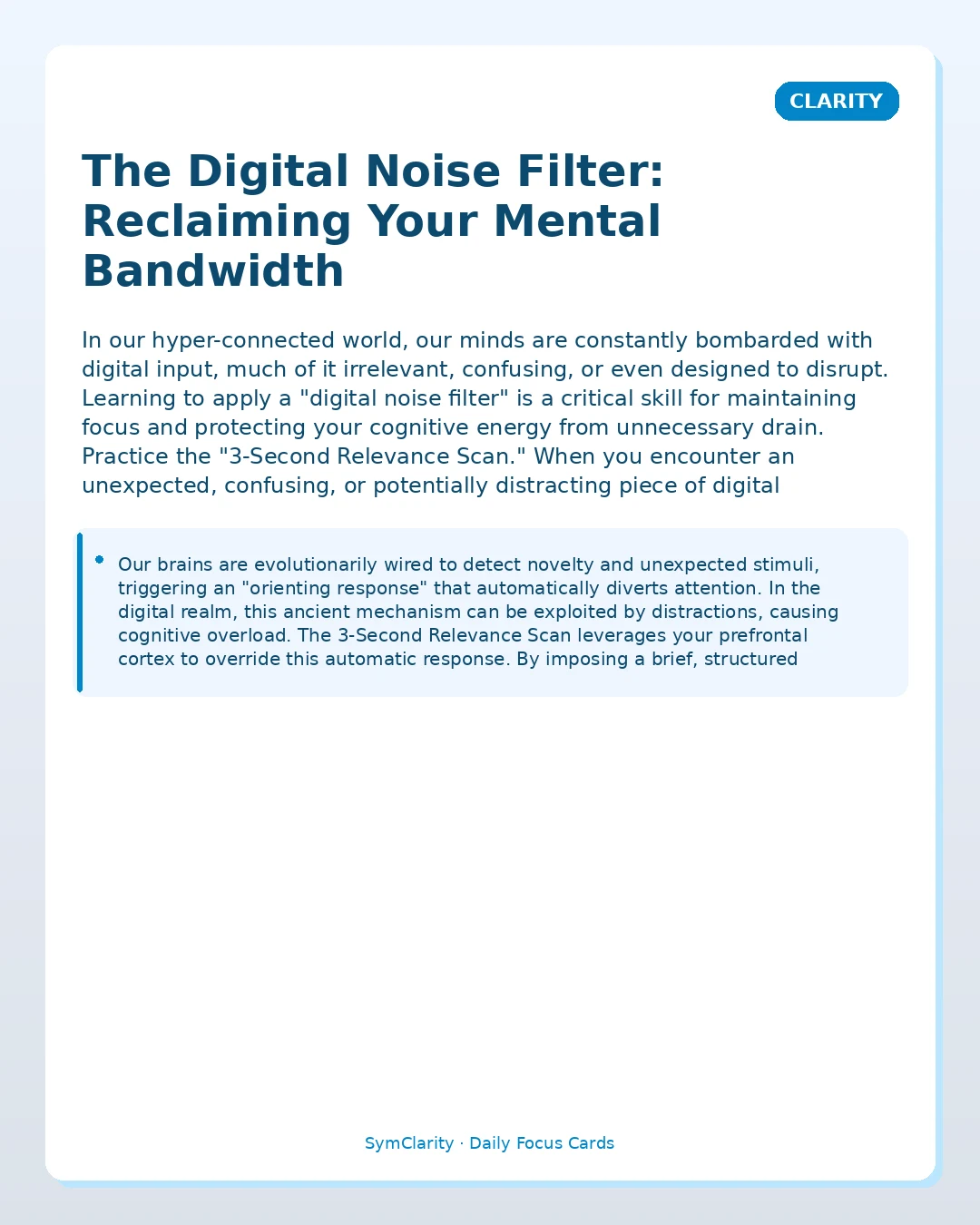
The Digital Noise Filter: Reclaiming Your Mental Bandwidth

In our hyper-connected world, our minds are constantly bombarded with digital input, much of it irrelevant, confusing, or even designed to disrupt. Learning to apply a "digital noise filter" is a critical skill for maintaining focus and protecting your cognitive energy from unnecessary drain. Practice the "3-Second Relevance Scan." When you encounter an unexpected, confusing, or potentially distracting piece of digital information (like an odd notification, an unusual data string, or an irrelevant pop-up), pause for precisely 3 seconds. During this brief pause, ask yourself three targeted questions: 1) Is this directly relevant to my current goal or task? 2) Does this require immediate attention? 3) Is this information credible and useful? For example, imagine you are deep into a complex financial analysis, and an unintelligible error code or a peculiar string of characters appears on your screen. Instead of immediately engaging or feeling derailed, apply the 3-Second Relevance Scan. If the answers to your questions are consistently "no," mentally tag it as "noise," take action to dismiss it if possible, and redirect your attention immediately back to your primary task. This swift, conscious disengagement prevents the costly context-switching that can severely impact your productivity.

View Full Card Share Download
Clarity card: The Digital Noise Filter: Reclaiming Your Mental Bandwidth - Daily focus inspiration from SymClarity
Focus
Sep 16, 2026

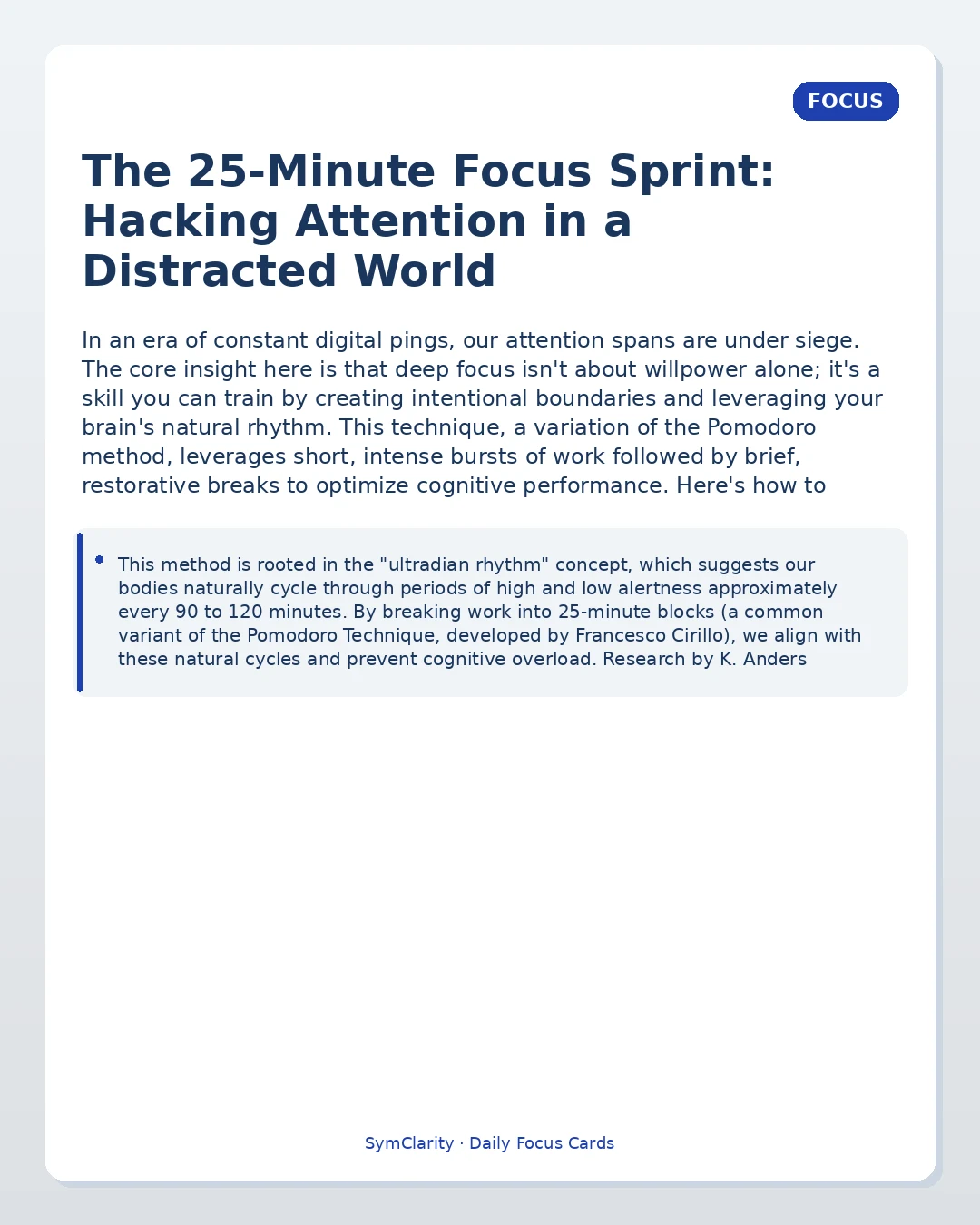
The 25-Minute Focus Sprint: Hacking Attention in a Distracted World

In an era of constant digital pings, our attention spans are under siege. The core insight here is that deep focus isn't about willpower alone; it's a skill you can train by creating intentional boundaries and leveraging your brain's natural rhythm. This technique, a variation of the Pomodoro method, leverages short, intense bursts of work followed by brief, restorative breaks to optimize cognitive performance. Here's how to implement your 25-Minute Focus Sprint right now: 1. Select Your Single Task: Identify one specific, high-priority task you want to complete. Avoid multitasking. Write it down. 2. Eliminate Distractions (The 3-Step Lockdown): Step A: Put your phone on silent and place it face down, out of arm's reach. Step B: Close all unnecessary tabs and applications on your computer. * Step C: Inform colleagues or family members you're entering a "focus zone" for the next 25 minutes. 3. Set a Timer: Use a physical timer or a simple app for precisely 25 minutes. 4. Immerse Yourself: Work relentlessly on your chosen task until the timer rings. If a distraction arises, jot it down quickly on a notepad to address later, then immediately return to your task. 5. Take a 5-Minute Break: When the timer goes off, stop immediately. Step away from your workspace. Stretch, grab water, look out a window. Do something completely unrelated to your task. Avoid checking emails or social media during this break. 6. Repeat: After the break, start another 25-minute sprint or move to a different task. Real-world example: Imagine you need to draft an important report. Instead of trying to power through for hours, you commit to three 25-minute sprints. The first sprint is for outlining, the second for drafting the introduction, and the third for the main body. During your 5-minute breaks, you stand up and walk to the kitchen for a glass of water, returning refreshed for the next sprint. This structured approach prevents mental fatigue and keeps you consistently productive.

View Full Card Share Download
Focus card: The 25-Minute Focus Sprint: Hacking Attention in a Distracted World - Daily focus inspiration from SymClarity
Perspective
Sep 16, 2026

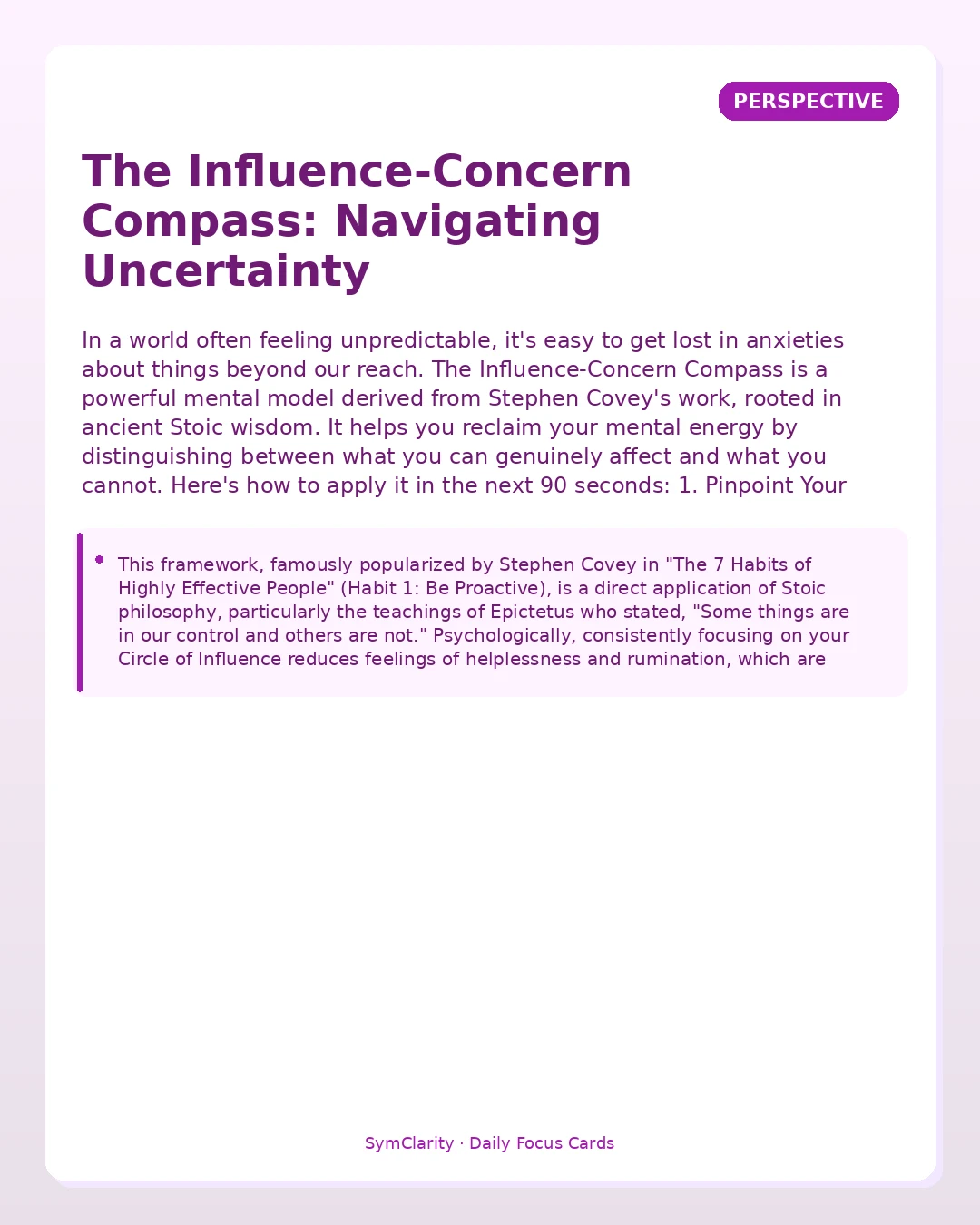
The Influence-Concern Compass: Navigating Uncertainty

In a world often feeling unpredictable, it's easy to get lost in anxieties about things beyond our reach. The Influence-Concern Compass is a powerful mental model derived from Stephen Covey's work, rooted in ancient Stoic wisdom. It helps you reclaim your mental energy by distinguishing between what you can genuinely affect and what you cannot. Here's how to apply it in the next 90 seconds: 1. Pinpoint Your Current Unease: Identify a specific worry or source of uncertainty currently occupying your mind. It could be global news, a personal challenge, or a future unknown. 2. Visualize the Circles: Mentally draw two concentric circles. Label the inner, smaller circle "Circle of Influence" and the outer, larger circle "Circle of Concern." 3. Sort Your Thoughts: Take your identified worry and break it down. List out all the specific aspects related to it. For each aspect, ask yourself: "Can I directly control or significantly impact this?" - If yes, place it in your "Circle of Influence." (e.g., my personal daily actions, my attitude, my learning, how I prepare, who I support directly). - If no, but you still care about it, place it in your "Circle of Concern." (e.g., global political decisions, the weather, others' opinions, market fluctuations beyond your control). 4. Reallocate Your Focus: Consciously commit to dedicating 80% of your mental energy for the next 24 hours solely to the items within your "Circle of Influence." For example, if you're worried about climate change, your "Circle of Concern" might include global emissions targets, but your "Circle of Influence" would include your personal consumption choices, advocating locally, or supporting sustainable initiatives. This isn't about ignoring concerns, but strategically directing your finite energy.

View Full Card Share Download
Perspective card: The Influence-Concern Compass: Navigating Uncertainty - Daily focus inspiration from SymClarity
  • Previous
  • 1
  • 2
  • 3
  • 4
  • 5
  • 51
  • 52
  • Next
464 Total Cards
211 Days Active
29 Categories

Explore Card Categories

Discover specialized collections of cards for every aspect of your personal growth journey.

Mindfulness Cards

Daily meditation practices for stress relief and mental wellness.

Explore Mindfulness

Productivity Cards

Time management and focus techniques for peak performance.

Explore Productivity

Wellness Cards

Holistic health practices for physical and emotional well-being.

Explore Wellness

Create New Card

Generate your own personalized card and contribute to the community gallery.

Create New Card

View My Cards

Access your personal collection of clarity cards and track your journey.

View My Cards

Privacy Policy

Learn how we protect your data and ensure your privacy is respected.

Privacy Policy
Transform how you experience each moment.
© 2025 SymClarity
[email protected]

Creating your clarity card...

You're offline. Some features may not be available.

Cookie Preferences

We use minimal analytics cookies to improve your experience. You can manage your preferences below.