The "Resilience Reframe": 3 Minutes to Pre-Empt Uncertainty

Your daily focus card - a moment of clarity in your journey.

Resilience

The "Resilience Reframe": 3 Minutes to Pre-Empt Uncertainty

Your brain's natural tendency is to avoid pain and seek certainty. When faced with global or personal uncertainty, this can manifest as chronic worry or overwhelm. The "Resilience Reframe" is a proactive psychological strategy, adapted from Stoic philosophy and modern strategic planning, designed to transform abstract fear into actionable preparedness. Here's how to apply it: 1. Identify the Unspoken Fear (1 minute): Take a moment to acknowledge a specific, looming uncertainty that's causing you unease—it could be a personal challenge, an economic concern, or a global event. Instead of pushing it away, allow yourself to mentally articulate the worst-case scenario associated with it. Don't dwell; just bring it into conscious awareness. 2. The "Pre-Mortem" Pivot (1 minute): Now, immediately shift your perspective. Imagine that worst-case scenario has already happened. From this imagined future, ask yourself: "What single, small, concrete action could I have taken beforehand to either prevent this, mitigate its impact, or better cope with it?" Focus on something within your sphere of influence. 3. Commit to a Micro-Action (1 minute): Identify one of those preventative or coping actions. It doesn't need to solve everything, just be a small, tangible step. For example, if you're worried about financial instability, your micro-action might be to review your budget for 5 minutes, or research a new skill. If you'sre concerned about social division, it might be to initiate a respectful conversation with someone of a differing view, or volunteer for a community project. Take that single step within the next hour.
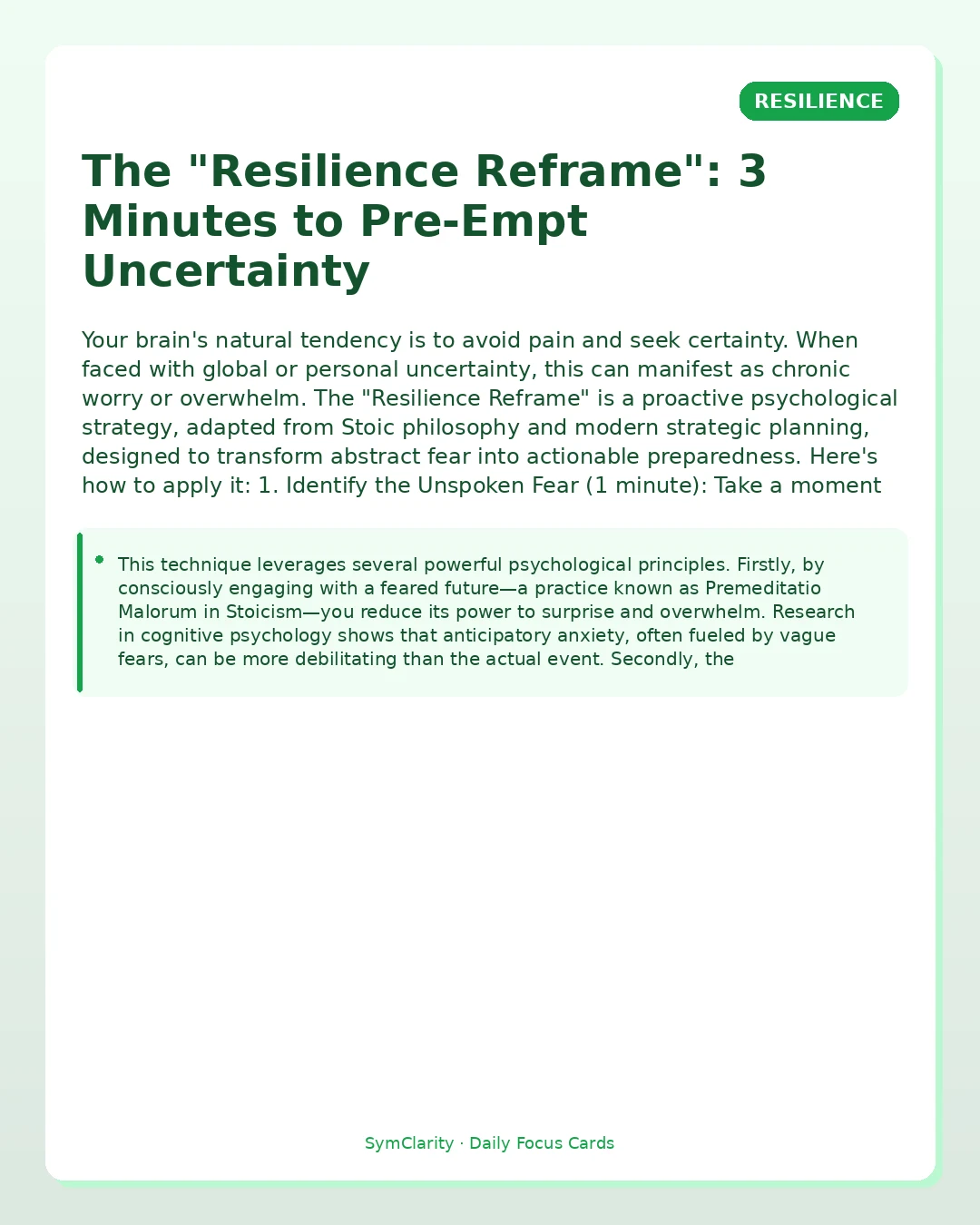
This technique leverages several powerful psychological principles. Firstly, by consciously engaging with a feared future—a practice known as Premeditatio Malorum in Stoicism—you reduce its power to surprise and overwhelm. Research in cognitive psychology shows that anticipatory anxiety, often fueled by vague fears, can be more debilitating than the actual event. Secondly, the "pre-mortem" approach, popularized in decision science by Dr. Gary Klein, forces a shift from passive worry to active problem-solving. This mental rehearsal doesn't invite negativity; it builds self-efficacy and perceived control, which are critical buffers against stress. Studies indicate that individuals who engage in proactive coping strategies report lower levels of distress and higher resilience when faced with adverse events. By breaking down large, amorphous fears into small, actionable steps, you activate the prefrontal cortex, shifting away from the amygdala's fight-or-flight response towards rational planning and empowerment. This 3-minute exercise is a direct challenge to learned helplessness, reinforcing your capacity to influence your world, one small, intentional step at a time.
"
Download
My Cards Create Another Card

Continue Your Journey

Explore more ways to find clarity and focus in your daily life.

Create Another Card

Generate a new personalized card to maintain your daily focus and clarity.

Create New Card

View My Cards

Access your personal collection of clarity cards and track your journey.

View My Cards

Explore Gallery

Browse inspiring cards from the community for motivation and ideas.

Explore Gallery